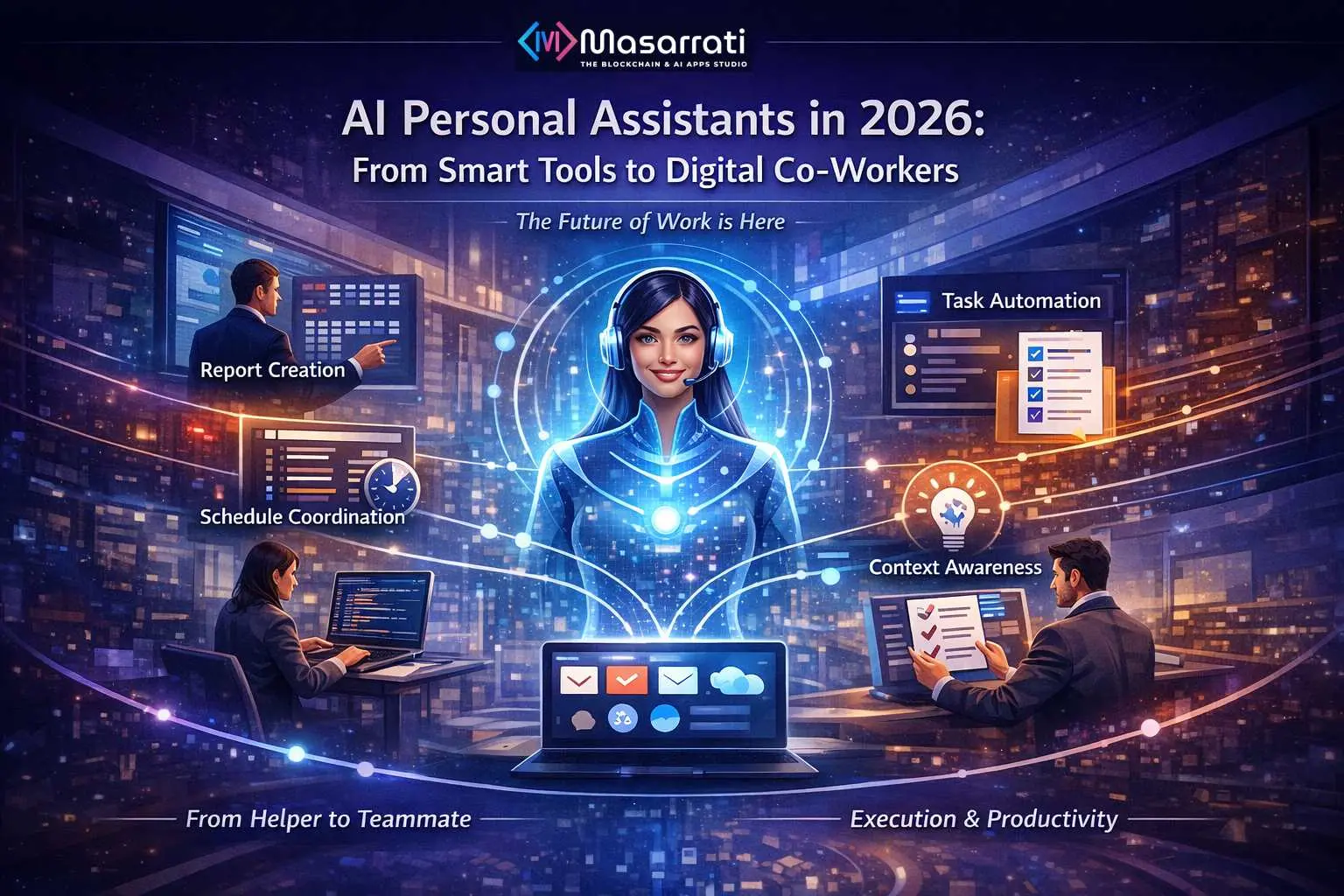
Artificial Intelligence is entering a new phase. What began as chat-based assistants that answered questions and generated text is now evolving into something far more practical — AI personal assistants that actively support, coordinate, and execute real work.
In 2026, AI personal assistants are no longer experimental add-ons. They are becoming a core productivity layer across modern organizations. From founders and executives to developers and operations teams, AI assistants are turning into always-available digital co-workers.
At Masarrati, we see this shift not as a feature trend — but as a platform transformation.
This article explores the most important AI personal assistant trends in 2026, and how they are reshaping the way teams work.
The Shift From Conversation to Execution
The first generation of AI assistants focused on conversation. They answered questions, wrote drafts, and summarized documents. That was useful — but limited.
The 2026 generation of AI personal assistants focuses on execution.
Modern assistants can now:
- Prepare reports
- Draft and structure communications
- Coordinate schedules
- Organize information
- Support operational workflows
- Handle multi-step tasks
The user experience is changing from:
“Give me information”
to
“Handle this task.”
This execution-first model is what makes today’s AI assistants truly valuable in daily work.
Context Awareness Is Becoming a Core Capability
AI assistants are becoming increasingly context-aware. Instead of treating every interaction as new, modern assistants understand continuity.
They adapt to:
- User preferences
- Ongoing projects
- Repeated workflows
- Communication style
- Business context
This allows the assistant to deliver outputs that are more relevant, more personalized, and more aligned with how teams actually operate.
The result is less repetition, fewer prompts, and faster outcomes.
Multi-Step Task Handling Is a Breakthrough Moment
One of the most important developments in AI personal assistants is the ability to manage multi-step tasks.
Instead of responding once, assistants can now plan and complete structured sequences of work.
For example:
User goal: Prepare a weekly performance update
Assistant workflow:
- Collect latest data
- Summarize key metrics
- Structure insights
- Draft update
- Format output
This kind of chained reasoning and structured execution is turning AI assistants into real workflow partners — not just text generators.
AI Assistants Are Becoming a Layer Across Work Tools
Another major trend in 2026 is integration depth.
AI assistants are no longer isolated in a single app. They are becoming a layer across everyday work environments.
We are seeing assistants embedded into:
- Messaging platforms
- Collaboration tools
- Internal dashboards
- Knowledge systems
- Reporting environments
This reduces friction and improves adoption because users don’t need to change where they work — the assistant comes to them.
The most successful AI assistant experiences are embedded, not separate.
Businesses Are Standardizing AI Assistants Across Teams
AI personal assistants are moving from individual usage to team-wide and organization-wide adoption.
Common business use cases now include:
- Executive assistance support
- Sales communication drafting
- Operations reporting
- Meeting summaries
- Research assistance
- Knowledge retrieval
- Workflow coordination
What was once optional is becoming standard. Organizations increasingly expect AI assistance to be available across functions.
This is similar to how cloud collaboration tools became universal over the last decade.
Speed and Clarity Are the New Productivity Metrics
Productivity in 2026 is measured less by output volume and more by response speed and decision clarity.
AI personal assistants help teams:
- Reduce preparation time
- Accelerate drafting
- Shorten analysis cycles
- Improve response quality
- Move from idea to execution faster
The competitive advantage is not just automation — it is momentum.
Teams supported by capable AI assistants simply move faster.
Specialized AI Assistants Are Replacing Generic Ones
We are also seeing a move toward specialized assistants.
Instead of one general assistant for everything, organizations are adopting role-aligned assistants such as:
- Developer assistants
- Sales assistants
- Operations assistants
- Research assistants
- Executive assistants
Specialization improves usefulness, accuracy, and adoption because the assistant understands the domain language and workflow expectations.
This trend will accelerate as more vertical AI products emerge.
AI Assistants Are Becoming Digital Teammates
Perhaps the most interesting shift is cultural.
Users increasingly describe AI assistants as collaborators rather than tools. The language is changing:
From:
I used an AI tool
To:
My assistant helped me complete this
That shift reflects trust and dependency — two signals that a technology has moved into daily workflow reality.
AI assistants are becoming part of the team.
The Masarrati Perspective
At Masarrati, we believe AI personal assistants represent a foundational shift in how software is experienced.
The future is not software that waits for commands.
The future is software that assists, coordinates, and executes alongside you.
The next generation of enterprise platforms will not just include AI features — they will be designed around AI assistants as an interaction layer.
Organizations that adopt this model early will gain measurable advantages in speed, clarity, and operational efficiency.
Final Outlook for 2026 and Beyond
AI personal assistants are moving from:
- Smart chat → Structured execution
- Helpful tool → Workflow partner
- Optional add-on → Core productivity layer
The trajectory is clear. AI assistants will become ambient — present wherever meaningful work happens.
The question is no longer whether teams will use AI assistants.
The real question is:
How deeply will they integrate them into their workflows?